COVID_Health_Care_Trends_MARC_and_Cigna_March
Market Research Summary
Section 1: COVID-19 General Population Findings
About the Survey
Cigna and M/A/R/C® Research conducted an online survey among US consumers 21 years and older to understand the impact of the COVID-19 crisis. The research measured the perceived effect of the pandemic and other health behaviors. Survey fielded Mid-February 2021, sample size general population; n=1,695.
Activities
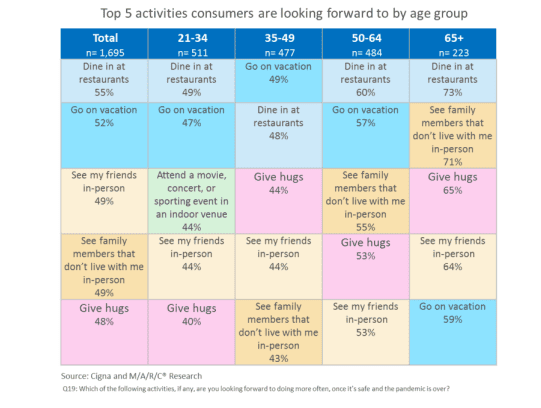
Dining at restaurants, vacationing, seeing family and friends in person, and giving hugs are what people are looking forward to doing more often once the pandemic is over.
- 52% look forward to going on vacation once the pandemic is over, though it will likely be a domestic destination, as hesitancy remains regarding international travel. Only 26% of people would travel internationally.
- Among those age 65+, 73% are looking forward to restaurant dining, 71% to seeing family members in person, and 64% to seeing friends in person. Also, 65% of people 65+ are looking forward to giving someone a hug once the pandemic is over.
Relationships
The pandemic has strengthened relationships with children, significant others and therapists, and in particular for men more than women.
- 1 in 2 adults (55%) with kids say their relationship changed for the better; 30% say it is significantly better.
- Across all those surveyed, 41% say relationships with significant others improved as a result of the pandemic. 43% say their relationships are about the same, and 16% say that their relationships changed for the worse.
- 42% report an improvement in their relationship with a therapist.
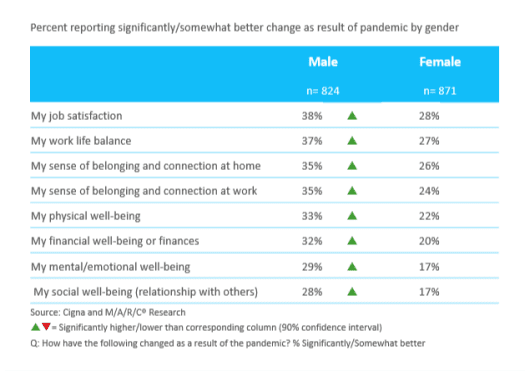
Men report a significant improvement across all relationship categories compared to women.
- 47% of men report an improvement in relationships with children compared to 36% of women.
- 47% of men report an improvement in their relationship with significant other compared to 34% of women.
- 39% of men see an improvement in their relationship with co-workers compared to 30% of women.
- 40% of men report a change for the better in their relationships with work supervisors, compared to 28% of women.
Work Life Balance
The impact of the pandemic for men and women is significantly different. Women have been harder hit regardless of health insurance presence. When asked about how particular aspects of their lives have changed as a result of the pandemic, women are more likely to report a change for the worse compared to men in several areas, including mental/emotional well-being, physical well-being, financial well-being, social well-being and sense of belonging at work. In fact, for individuals with or without health insurance:
- 35% of women say their mental/emotional well-being changed for the worse compared to 27% of men.
- 1 in 4 women (26%) say their physical well-being deteriorated compared to 1 in 5 (20%) men.
- 34% of women say their financial well-being deteriorated compared to 30% of men.
- 33% of women feel that their social well-being changed for worse compared to 27% of men.
- 29% of women say their sense of belonging and connection at work changed for the worse, compared to 24% of men.
- Women are less optimistic that the pandemic will be over soon, with 45% disagreeing with the statement, “I’m optimistic that this pandemic will be over soon” compared to 39% of men. Furthermore, 86% of women agree with the statement “I feel the pandemic will go on for longer” compared to 82% of men.
Men report a change for the better in all dimensions measured.
Virtual Care
Awareness of virtual care continues to be strong, with 91% of respondents being aware. Awareness is higher among people with health insurance, with 94% being aware.
- About 1 in 2 (47%) of those aware have used virtual care and most used it during the pandemic.
- 85% of those that used virtual care, did so within the past year.
- Individuals 50+ are more likely to have used virtual care within the past year than any other group.
- 94% of those 50-64 and 97% of those 65+ report using it less than a year ago.
- Women are more aware of virtual care than men (93% vs 90%) but men have a higher overall adoption than women. Of those aware, 49% of men say they have used it vs 45% of women.
- However, over the pandemic period women have used it more than men: 89% of females who have used it say they have done so within the past year compared to 80% of males.
- Top reasons for utilization during the past year/pandemic are:
- Routine care (44%)
- Behavioral/mental/emotional health (36%)
- Wellness/preventative care (33%)
- Sick visits (26%)
- Urgent or immediate care (14%)
- Musculoskeletal (12%)
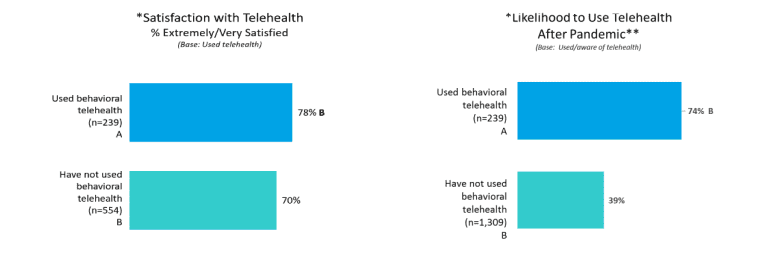
- Consumers are satisfied with receiving behavioral/mental health virtually and are likely to continue using it.
- 78% of individuals who used behavioral telehealth are very/extremely satisfied with telehealth vs 70% of those that did not use behavioral telehealth.
- 74% of those who used behavioral telehealth are more likely to use telehealth again after the pandemic, compared to 39% of those who did not used behavioral telehealth.
Behavioral virtual care is making a difference at home and at work.
- 41% of those who used behavioral telehealth during the pandemic say their overall mental well-being is better, compared to 26% of those who did not use behavioral virtual care.
- About 40% (37%) of those who used behavioral virtual care are more likely to maintain a positive attitude vs 23% of those who did not use it.
- 44% of users report feeling more able to take care of themselves and family, compared to 26% of those who have not used behavioral virtual care.
Resilience
Individuals with higher resilience are more likely to report better overall health than less resilient. 64% of the more resilient group say their health is very good or excellent compared to 41% of the less resilient group.
Higher resilient individuals report managing all health and well-being dimensions better than less resilient.
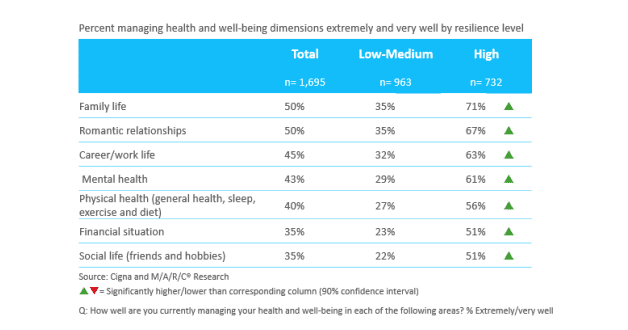
More resilient are more likely to report a positive change as result of the pandemic than less resilient.
Less resilient people are not engaging in stress reduction activities.
- 48% of the less resilient group says they’ve never engaged or infrequently engaged (less than once a week) in stress-reduction activities in a typical month.
- Moreover, almost 1 in 3 (32%) of the less resilient say they never engage in stress-reduction activities compared to 25% of the more resilient group.
Less resilient people are not as engaged in religious or spiritual activities.
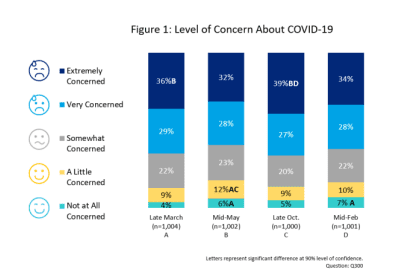
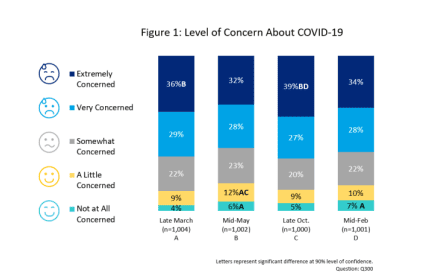
Concern about COVID-19 has decreased since late October
- In October 2020, about 40% of people said they were extremely concerned about COVID-19, while in midFebruary 2021, 34% report feeling extremely concerned – a six-point decrease.
- Individuals between the ages of 35- 49 have seen a significant decrease in concern from 51% in October to 41% in February 2021.
- Wearing a face masks and handwashing are the top measures people are taking to prevent the spread of COVID-19.
- 78% report wearing a face mask and 72% washing hands more frequently.
- Avoiding large gatherings has decreased since the beginning of the pandemic (March ‘20), when 75% reported avoiding large gatherings compared to February 2021 when 67% report avoiding large gatherings.
- Individuals aged 50+ are keeping up the most with actions to help prevent the spread of COVID-19, such as wearing masks, avoiding large gatherings, hand washing, social distancing, etc.
- Although government stay-at-home orders have decreased, people are choosing to remain home on their own as a way of minimizing the spread of COVID-19, mostly driven by those 50 years and older. In general, 44% of people reported choosing to stay at home in Feb 2021 vs 39% in March 2020.
Stress levels are leveling off, and people are more optimistic about their health.
- In late October 2020, 1 in 3 reported a significant increase in their stress levels. Almost four months later, 1 in 4 report a significant increase.
- In February 2021, 61% say they believe their overall health will be better after the pandemic is over, compared to 45% in March 2020 ̶a 16-point increase in those feeling optimistic about their health after the pandemic.
People are choosing to do more activities that are good for their long-term health – with parents and men more likely to stay active than women.
- 31% say they are exercising more a year after the pandemic than early in the pandemic, when 28% said they were exercising more.
- 76% state they’ve done some type of physical exercise at least once a week over the last month.
- This is particularly so among males, respondents younger than 50 and those with children.
- About 80% of those younger than 50 report engaging in physical activity at least once a week compared to 69% of those aged 50 – 64.
- Men are more likely to exercise at least once a week compared to women. 81% report engaging in physical activity at least once a week in the last month, compared to 72% of women.